Minuit 47 & Cie Sang-Gênes
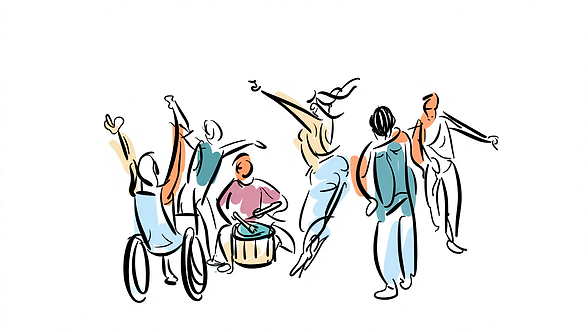


AURA is a wireless musical device that transforms movement into sound.
Based on body sensors, AURA detects both large movements such as walking and arm movements, as well as fine movements such as finger flexion, and even certain biometric data (muscle activity via EMG, heart rate).
These signals become musical elements: a moving finger produces a violin note, a hand tremor creates a vibrato, a stride or heartbeat triggers percussion, a raised arm activates effects, morphing, saturation, or reverb. Each gesture can thus generate a sound, an instrument, or an electronic texture, offering infinitely modulable compositional possibilities.
Accessible to everyone, including people with disabilities, children, artists, and more, AURA values movement, sensory experiences, and co-creation.
Driven by an inclusive artistic approach and rooted in scientific research, the project explores new forms of expression. Its prototype is designed to be reusable, adaptable, and shared by different organizations.
AURA operates across borders between Luxembourg and France, through the collaboration of Minuit 47 and Cie Sang-Gênes, supported by a jointd network of cultural, scientific, financial, and medical-social partners.
AURA is supported by Rotondes (LU), BLIIIDA (FR), PWC (LU), IRCAM (FR), GAPAS (FR), Audio Modeling (it), LUTIN (Cité des Sciences, FR)
Benjamin Gabriel

Benjamin Gabriel is a composer, musician, and comedian. Self-taught pianist and experienced in music production, he trained in music and theater before perfecting his skills at the Bill Evans Piano Academy. He collaborates with various artists and companies, developing both his instrumental practice and his approach to the stage, and also works as an assistant director. He composes for theater, designing soundscapes that interact with the texts and scenography, and collaborates with directors on contemporary and multidisciplinary creations. His musical practice extends to other art forms, developing research into the interactions between music, movement, and technology, and exploring new immersive and accessible forms of sound creation. At the same time, he is developing an inclusive educational approach, offering music workshops open to all, including people with disabilities. These projects focus on collective creation, accessibility, and sound experimentation in collaboration with specialized organizations. He founded the non-profit organization Minuit 47 in Luxembourg, dedicated to the development of trans-border artistic projects and the exploration of accessible and participative musical practices.
Victor Paredes
Victor Paredes has a dual background in technology and music. He holds a PhD in computer music from IRCAM and works as a sound interaction designer. He graduated from ENS Cachan in mechanical engineering, holds the French agrégation, and also trained in saxophone at the Hérouville-Saint-Clair Conservatory. At the intersection of these disciplines, he completed his PhD at IRCAM, exploring interactive systems linking movement and sound in artistic contexts. This research and creative work led him to collaborate with dancers on the piece Sympoiesis with Laurane Le Goff, as well as with circus performers from the CNAC in collaboration with IRCAM at Cirque Electrique. He specializes in the use of motion sensors and in helping artists, composers, and a wider audience to appropriate these technologies. He also uses his skills in generative video creation to enhance the immersive experience of these devices. At the same time, he teaches mechanics, computer science, and electronics at Sorbonne University and IRCAM. He worked as an R&D manager for the Koral project, offering accessible musical interactions for audiences with disabilities via smartphones connected to a computer.

Artistic team
AURA offers a range of experiences tailored to different contexts and audiences: participatory workshops, conferences and presentations, permanent installations, educational and co-creation workshops sessions.
1. Participatory workshops
The workshops are moments of collective creation and discovery of musical and digital culture.
Participants, along with artists, play with sensors, explore sounds, and try out different ways to make music through movement.
For workshops with people with disabilities or special needs, we coordinate with the professionals accompanying them to make sure the tools and formats are adapted to their needs.
2. Conferences and presentations
These events feature interactive demonstrations, audience discussions, and feedback on accessibility, sensory experience, and technological innovation. They target diverse audiences at festivals, conferences, cultural events, and universities.
The presentations showcase AURA’s multidisciplinary approach, combining art, science, and technology, while promoting awareness of the importance of inclusion in music creation
3. Permanent installations
Designed for venues with a continuous flow of visitors, such as museums, libraries, or festivals, this version of the device allows open interaction with AURA. Visitors can actively participate by manipulating the sensors to create music, or simply observe as spectators.
These installations can be incorporated into scenographies or enhance thematic exhibitions on sound, the body, or technology, providing an immersive and accessible experience.
4. Educational and co-creation workshops
Aimed at young people with limited access to culture or facing academic challenges, these workshops can run from one week to a month.
Participants contribute to creating the prototype: learning welding, mechanics, and electronics to build sensors, exploring software to collect and process data, and combining their work in a collective musical composition.
These workshops seek to develop technical and digital skills while fostering collective creativity and inclusion.
Expected impacts
1. For audiences
-
Access to music and physical activities for everyone, including isolated individuals, those in precarious situations, or people with disabilities.
-
Strengthening connections with local culture and its stakeholders.
-
Social and cultural integration in cultural venues.
-
Exploration of digital and immersive art.
2. For venues
-
Development of new ways to engage audiences.
-
Transformation of professional relationships: from a “doing for” to a “doing with” approach.
-
Shared and inclusive mediation.
-
Possibility of extending collaborations beyond residencies.
3. For artists
-
Adjustment of sensors according to participants’ profiles, with potential reuse in other workshops.
-
Selection of the most engaging sound associations for each audience.
-
Enrichment of the artistic approach through interactions with a diverse range of participants.
-
Provision of the device to artists, allowing them to adapt AURA to their practice and audiences.
AURA is produced as part of the GRACE project, dedicated to making arts education accessible to all residents of la Grande Région, supported by the Interreg Grande Région 2021–2027 program.
The work is created as part of a joint residency program between Les Rotondes, the City of Metz, and BLIIIDA, with the support of the INTERREG program via the INTERREG GRACE project.
Work produced with the support of the PwC Luxembourg Foundation under the aegis of the Fondation de Luxembourg.
